Induction Loop Testing Equipment

 Satellite III Induction Loop Assistive
Listening System -- Specifications & Installation Considerations
Satellite III Induction Loop Assistive
Listening System -- Specifications & Installation Considerations
- One Satellite III loop amplifier with built in 2 space rack mount & feet for free standing operation
- One 250 foot spool of 14 gauge two conductor clear wire or one 500 foot spool of 14 gauge single conductor black/white wire.
- One HLR III Loop Receiver with lightweight headphones & LED signal display
- One 6-foot phono plug patch cord
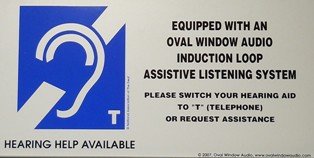
- One wall mountable sign
- Instructions & unlimited tech support
The Satellite III is designed to interface with existing public address systems and is our most popular and cost effective large area induction loop assistive listening system. It is often used in houses of worship, libraries, auditoriums, meeting rooms and theatres, providing coverage of up to 300-325 feet in perimeter. If larger areas need to be looped, multiple Satellite III systems may be linked, with each system covering no larger than a 300-325 foot perimeter area. Alternatively, two Satellite III amplifiers may be bridged enabling powering of a loop perimeter up to 500 feet.
The Satellite III is compatible with all telecoil-equipped hearing aids, cochlear implants and induction loop receivers.
The Satellite III amplifier is designed to be free standing or rack mounted using its built in 2 space rack mount. The amplifier should not be placed near a heat source. At least 1 rack space above and below the amplifier is necessary to permit adequate air circulation.
The Satellite III may be interfaced with any audio line level signal available from the sound system mixer/mixer-amplifier. Appropriate outputs are usually identified as “line
out” or “auxiliary output.” The Satellite III amplifier’s unbalanced phono input jack is recommended for most installations where the signal feed is short (less than
6 feet). If the signal feed is longer, the balanced input should be used to minimize noise.
If an audio line output is not available, the CV-600
loudspeaker to line level adapter may be used.
LOOP WIRE INSTALLATION INFORMATION:
Please note: Oval Window Audio loop wires are not rated for use in plenum
air spaces.
- The Satellite III system includes a 250 foot spool of two conductor 14 gauge clear wire, or a 500 foot spool of 14 gauge single conductor black/white wire. The actual perimeter of (each) area to be looped should not exceed 325 feet per loop system unless a dual amplifier bridged system is used.
- The total 14 gauge run of a single loop amplifier wire + lead in should be at least 300 feet so as to present the proper minimum 0.75 Ohm load to the amplifier. If longer lead in wire (<100 feet) is needed, exceeding what is available on the supplied spool, it should be at least 10-12 gauge in order to minimize signal losses. The loop lead in wire may be twisted to minimize signal bleed to nearby low level audio/video lines or sensitive equipment.
- When looping smaller areas (75-125 feet), 20 gauge wire may be provided or multiple series of 14 gauge single loop wire must be installed (for example, two turns around a 150 foot perimeter area). A two turn series loop will result in a 3 dB boost in the signal strength.
Important: Installing a “two turn series loop” means running a single wire once around, and then continuing around the perimeter one more time in the same direction. This effect may also be achieved by using the two conductor wire connected in series for perimeters of 125 to 250 feet (please click here to see "How to Make a Two Turn Series Loop").
Satellite III Technical Specifications
Inputs & Outputs:
- Two unbalanced paralleled phono jack line inputs, 10-100k Ohms impedance, 50-500mv input
- One balanced screw terminal input: from left to right: ground + - (600 Ohms impedance)
- Two screw terminal loop wire outputs, 1 and 8 Ohms (1 Ohm must be used with wire provided)
- One push-terminal 1 Ohm loop wire output for temporary (e.g. portable) applications
- Amplifier: 11.5 amps continuous output @ 1 kHz into 1 Ohm load
Controls & Visual Signal Indicators:
- Volume
- LED peak clipping indicator
- Adjustable non-distorting peak limiter
- Adjustable high frequency equalization (on rear panel)
Field Strength:
400 milliamperes/meter peaks, +/- 3dB, as measured 39” above the center of a 300 foot circumference 14 gauge loop wire as per IEC 60118-4 specifications
Frequency Response:
Equalized response of loop system is in accordance with IEC 60118-4 frequency response specification: 100 Hz – 5 kHz +/- 3dB
Loop Wire:
Depending on the planned loop dimensions, a 250-foot spool of 14 gauge stranded two conductor clear wire (.120" x .240" O.D.), or a 500-foot spool of 14 gauge stranded single conductor black/wire wire (.110" O.D.) is normally provided. Smaller gauge shorter wire may be provided for looping smaller perimeter areas. Please specify your preference for black or white wire. Larger areas may be covered by bridging two Satellite III amplifiers, or by using multiple systems.
Amplifier Power, Dimensions, Weight, Fuses:
115-120V AC, 2 amps/230 Watts (220-240V versions available for export), 19”W x 3 1/2”H x 11”D, built-in 2 space rack mount, 22 pounds, two internal 6 amp fuses (3AG)
Important Satellite III installation conditions and recommendations:
- To check loop performance, and interference with or from existing systems, the Satellite III must be set out (or tacked in place) and fully evaluated in the planned location before the final installation.
- If musical instruments with electromagnetic pickups (for example: electric guitars and some pianos) are routinely used in the areas to be looped, please email your message to info@ovalwindowaudio.com
* Using the Induction Loop Receiver or
FSM Loop Test Set (or equivalent), a
pre-installation listening check and measurement should be performed in the areas where loop systems will be installed to ensure that there are no sources of strong electromagnetic fields
(EMF) that can interfere with the system. Please contact Oval Window Audio for information concerning the
measurement and mitigation of EMF noise.
* The loop wire may be installed in wood construction, crawl spaces, under carpeting/wood flooring, in plastic conduit or clips on the wall, on/above ceiling
(<12 feet), or simply taped down for temporary use.
* The loop wire may be installed in existing concrete floors by cutting a 1/4” W x 1/2" D groove in the floor, placing the loop wire in the groove and filling in the space with epoxy sealer. This application must be tested before cutting the floor. Please email info@ovalwindowaudio.com regarding the use of "direct burial cable" for this application.
* The loop wire may be installed in a newly poured concrete floor by first running the wire through PVC conduit. The PVC conduit should be placed in the floor so that it is as far away from structural steel as possible and close to the flooring surface. This installation plan must be tested before the floor is poured.
* Conventional loops transmit signals that spill outside the looped listening areas. At least twice the length of the longest side of the loop must be allowed between looped areas on the same floor. In regard to loop systems on different floor levels, the systems should be separated by at least one half the length of the longest side of the loop wire.
Please email info@ovalwindowaudio.com regarding special techniques that may be used to reduce signal spill over.
* In order to maintain proper signal strength and signal uniformity, the loop perimeter in each listening area should not exceed 300-325 feet. The extra wire provided with the systems may be used as loop lead-in wire to connect to the loop amplifier. If longer lead-in wire (< 100 feet) is needed, 10-12 gauge wire is recommended in order to minimize power losses.
* Multiple Satellite III systems may be used to cover larger areas. As with stereo/multiple loudspeakers, multiple loop systems must be checked for proper phasing so that the loop signals are working to support each other. Correct phasing will generally occur if all loop wires are installed and connected to the loop amplifiers’ output terminals in the same orientation. For example, all loop wires can start at the “C/-“ terminal and be installed in a clockwise direction around the seating areas. Phasing of multiple loop systems should be confirmed by walking from one looped area to another while monitoring the signals. If the loops are out of phase, there will be a noticeable signal loss in the areas where the loop wires meet. The remedy is to reverse the phasing of one of the loop amplifier outputs. This can also be accomplished by changing the position of the (unmarked) phase reverse rocker switch on the rear of one of the Satellite III amplifiers.
* Under ideal conditions, larger areas up to 500 feet in perimeter, may also be serviced by bridging two Satellite III amplifiers. Please refer to information on the Satelllite III bridging sheet.
* Due to “dead spots” that occur directly above and below the loop wire, the sides of the installed loop wire should not be situated directly above or directly below seating within the listening area. The sides of multiple loop wires must meet in areas where there is no seating, such as in aisles.
* The loop wire must not be run in continuous contact with metal, either directly above or below the loop wire. Loop wires may cross ceiling framework and may briefly run behind metal furniture. At least 70% of the total loop must be free of metal obstructions.
* At least 70% of the loop wire should be installed in the horizontal plane.
* To enhance signal uniformity, the loop wire can be situated above the
listening area at a height not exceeding 12 feet. Please email info@ovalwindowaudio.com for information on
planned loop heights > 12 feet.
* The loop wire must completely encompass the listening area.
* Avoid running loop wire in close proximity and parallel to telephone lines, microphone cords and video feeds and monitors. Maintain a distance of at least 6 feet and run full interference tests before final loop install. Microphone and video cables should be balanced and of the highest quality so as to avoid interference from the loop wire.
* The use of dynamic microphones can result in equipment feedback. To avoid this, whenever possible, use condenser microphones and/or keep dynamic microphones at least 10 feet from the loop wire. Run full interference tests before the final loop installation.
Summary of Satellite III Calibration Instructions:
• Set PA system for normal operating level
• Increase Satellite III volume control setting until Peak LED flashes brightly with audio signal
• Increase Satellite III limiter control setting until flashing of Peak LED diminishes slightly
• Using the Induction Loop Receiver, always begin system set ups with all inputs and output controls at MINIMUM settings, slowly increasing levels until proper signal is attained in the center of the loop. Correct signal strength will brightly light up the Induction Loop Receiver's LED when the receiver is held upright in center of the loop, and throughout the looped area. With calibrated measurement equipment, peak audio signals should reach 400 mA/meter, +/- 3 dB.
• Please email info@ovalwindowaudio.com to learn about certifying loop installations in accordance with the latest international standards.
Warranty
All Oval Window Audio products are sold on a 30-day satisfaction guaranteed basis and with a 3-year warranty covering parts and labor. Exceptions to this warranty include microphones, rechargeable batteries and ear/headphones which are guaranteed for 90 days. Warranty will be voided for equipment that has been abused, altered or operated in a manner contrary to directions contained in the user manual. A return authorization must be obtained for all equipment returns and servicing.
Unlimited technical support is included with all Oval Window Audio
products. Local authorized installers may also be available.
Oval Window Audio products are proudly manufactured in the U.S.A.

E-mail Oval Window Audio Today
Home // Hearing Loops // Induction Loop Assistive Listening Systems // Induction Loop Receivers // Induction Loop Testing Equipment // Vibrotactile/Multisensory Sound Lab // Loop Systems & Accessories Pricing & Ordering // Contact Us
This site created with the help of The
Write Direction.